Financial note: Loan approval, pricing, repayment terms, and eligibility depend on the lender’s assessment and the applicant’s profile. Borrow only what your business can reasonably repay, and review the full offer, fees, due dates, and consequences of late payment before accepting it.
Starting a business in Nigeria is exciting, but getting enough money to keep it moving can be difficult. You may need cash to buy stock, pay suppliers, purchase equipment, rent a shop, or take advantage of a good business opportunity before it disappears.
That is where a startup business loan can help. But a loan should not be treated as free money. The safest approach is to borrow for a clear business purpose, understand the full cost, and have a realistic plan for repayment.
In this guide, we explain how to get a startup business loan in Nigeria, what lenders usually consider, the documents you may need, and how to apply for a BAFF Business Loan.
What is a startup business loan?
A startup business loan is money borrowed by a new or growing business for a commercial purpose. Depending on the lender, it may be offered as a term loan, working-capital loan, credit line, asset-finance facility, or government-backed intervention fund.
For many small businesses, the most practical use is working capital. This could mean buying goods in bulk, restocking a shop, purchasing raw materials, paying suppliers, or handling a short gap between making a sale and receiving payment.
The important thing is to connect the loan to a specific business activity. For example, borrowing ₦300,000 to buy fast-moving stock is easier to assess than simply saying you need money “to grow the business.”
Can a new business get a loan in Nigeria?
Yes, but a new business may need to provide more evidence that it can repay the money. Lenders may look at your identity, business activity, transaction history, cash flow, credit behaviour, existing debts, and the reason for the loan.
Depending on the lender and product, you may also be asked for business-registration details, bank statements, invoices, supplier quotations, collateral, a guarantor, or proof that your business is already making sales.
Some government and development-finance programmes do not lend directly to entrepreneurs. Instead, applications may be assessed through participating financial institutions. The Central Bank of Nigeria’s MSME Development Fund, for example, says borrowers apply through nominated participating financial institutions, which review the economic and financial viability of each application.
How to get a startup business loan in Nigeria
1. Be clear about what the money is for
Before applying, write down exactly how you plan to use the money. Are you buying inventory? Paying a supplier? Purchasing equipment? Expanding your shop? Covering a temporary cash-flow gap?
A clear explanation makes your application stronger and helps you avoid borrowing for the wrong reason. “I need ₦300,000 to buy 40 units of a product that normally sells within 30 days” is much more useful than “I need money for my business.”
Business borrowing is generally better suited to productive expenses such as stock, equipment, supplies, delivery, or expansion. If you need money for school fees, personal rent, an emergency, or household expenses, a business loan may not be the right product.
2. Borrow only what you need
It can be tempting to request the highest amount available, but a larger loan also means a larger repayment obligation. Start with the smallest amount that can solve the business problem.
Prepare a simple cost estimate before you apply. Include the item you want to buy, its price, any transport or setup cost, your expected selling price, and how long it may take to sell.
| Item | Example amount | Why it matters |
| Inventory or equipment | ₦250,000 | Shows what the loan will fund |
| Transport and setup | ₦25,000 | Helps you avoid underestimating the cost |
| Expected sales revenue | ₦360,000 | Shows the possible source of repayment |
| Proposed loan amount | ₦275,000 | Keeps the request focused |
These figures are examples only. Use your actual supplier prices, sales records, profit margin, and repayment schedule.
3. Prepare your documents early
Do not wait until the application opens before looking for your documents. Make sure the information on your ID, bank account, wallet, and business records is accurate and consistent.
Depending on the lender, you may need a valid government-issued ID, an active bank account, proof of address, business-registration details, bank or wallet statements, invoices, supplier quotations, and evidence that the business is operating.
For a BAFF Business Loan, BAFF says applicants need a valid ID, an active bank account linked to their BAFF profile, and a Tier 3 BAFF account. Additional documents may be requested depending on the type of business.
4. Prepare a simple repayment plan
A lender will want to know how the loan will be repaid. You should know this too.
Write down your expected weekly or monthly sales, gross profit, regular expenses, current debts, and the amount you can comfortably put towards repayment. Use realistic figures. Do not base your plan only on your best sales day or on the assumption that every item will sell immediately.
Your repayment should leave enough money for restocking and normal business expenses. If repayment would take nearly all your expected profit, consider borrowing less or postponing the purchase until the numbers make more sense.
5. Compare the full cost of the loan
Do not look only at the advertised interest rate. Before accepting an offer, check the total amount you will repay, processing charges, service fees, insurance, repayment frequency, late-payment consequences, and early-repayment rules.
BAFF states that its business-loan rates start from 4%, although the exact rate depends on the applicant’s business profile and loan amount. The applicable rate is shown before the applicant accepts an offer in the app. A “from” rate is not a guarantee that every applicant will receive that rate.
6. Use official application channels
Apply through the lender’s official website, mobile application, branch, or verified partner. Be careful with people who promise guaranteed approval or ask you to pay a suspicious fee before releasing a loan.
Never give an unauthorised person your one-time password, card PIN, password, or other private security details. If you are considering a government or development-finance programme, confirm the current application process on the official programme website.
The Bank of Industry’s iProgrammes platform provides a central place to discover active intervention funds. It lists programmes such as GLOW and RAPID and directs applicants to the relevant programme portals.
The Development Bank of Nigeria also supports MSME lending through participating financial institutions, including through partial credit-risk guarantees and finance-to-finance on-lending. In practical terms, this means that an entrepreneur may need to apply through an eligible partner instead of applying directly to DBN.
7. Read the loan offer before accepting it
Approval does not automatically mean the loan is affordable. Check the amount you will receive, the total amount you will repay, the repayment dates, and what happens if you miss a payment.
Make sure the repayment schedule matches your business cash flow. Keep a record of every payment, and contact the lender early if you experience a genuine problem instead of waiting until the account becomes overdue.
Where can startups in Nigeria find business funding?
Different funding sources work for different businesses. A digital lender may be convenient for short-term working capital, while a bank or development-finance programme may be more suitable for a larger or longer-term facility.
| Funding source | May suit | What to check |
| Digital business lenders | Short-term working capital and inventory | Total repayment, fees, data permissions, and due dates |
| Commercial banks | Businesses with records seeking larger facilities | Statements, registration, collateral, and financial accounts |
| Microfinance banks | Micro and small businesses, including some informal traders | Pricing, repayment frequency, and licensing |
| Bank of Industry programmes | Applicants who meet a specific intervention programme’s criteria | Opening status, eligibility, application portal, and documents |
| Development-finance partner institutions | MSMEs seeking funding through participating institutions | Partner requirements and the terms of any guarantee-backed facility |
| Grants and equity investment | Businesses that want to reduce or avoid debt repayment | Eligibility, competition, reporting, and possible loss of ownership |
The CBN’s MSME Development Fund framework lists microfinance banks, NGO microfinance institutions, financial cooperatives, finance companies, development-finance institutions, and deposit money banks among eligible participating financial institutions, subject to the applicable programme window.
How to improve your chances of approval
The strongest applications are usually clear, consistent, and easy to verify. Keep records of sales, expenses, stock purchases, supplier payments, customer orders, and invoices. Where possible, separate business transactions from personal transactions so that your cash flow is easier to understand.
If you run a shop, stall, food business, POS operation, online store, or service business, keep evidence of your activity. This may include receipts, inventory records, supplier messages, invoices, customer orders, or other relevant business records.
Your application should answer four simple questions:
1.What does the business sell or provide?
2.How much money is needed?
3.What exactly will the money pay for?
4.Which sales or cash inflows will be used for repayment?
A short, honest explanation supported by numbers is more useful than a long application with no clear figures.
How to apply for a BAFF Business Loan
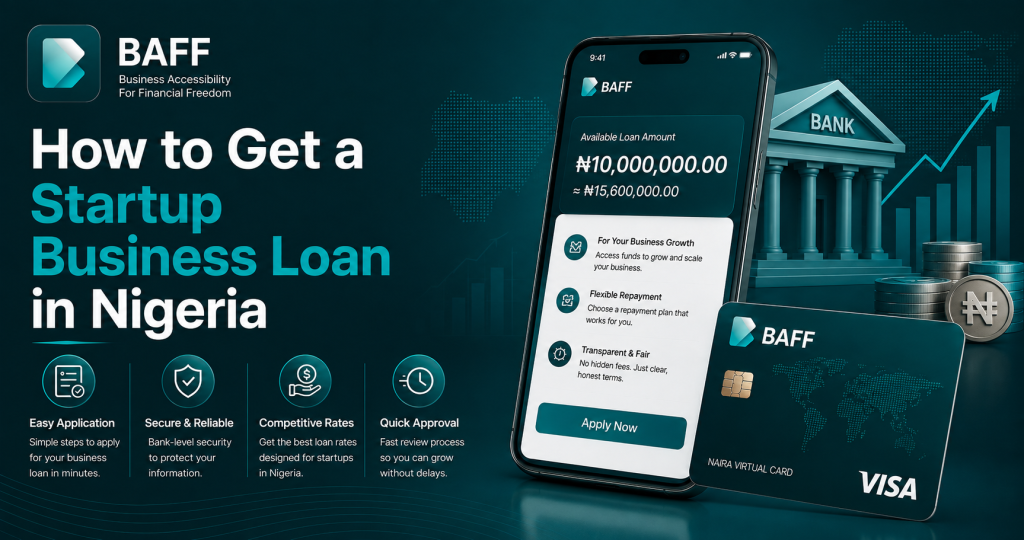
BAFF Business Loan is designed for Nigerian traders, shop owners, food vendors, wholesalers, retailers, and other small-business owners who need money for inventory, supplies, expansion, or day-to-day business operations. BAFF advertises business loans of up to ₦10 million, although each applicant’s available amount and terms depend on the lender’s assessment.
To begin your application:
2.Upgrade your account to Tier 3.
3.Complete the business-loan application with accurate information.
4.Review the approved amount, rate, repayment schedule, and total cost.
5.Accept the offer only if the repayment fits your business cash flow.
You can also learn more about BAFF Business Loans before applying. BAFF says applications are made through the app and that many applicants receive a decision quickly, but approval and timing are not guaranteed for every applicant.
Frequently asked questions
What documents do I need for a startup business loan in Nigeria?
Common requirements include a valid identity document, an active bank account, proof of address, business-registration details where applicable, bank or wallet statements, invoices, supplier quotations, and evidence of business activity. Requirements vary by lender. BAFF identifies a valid ID, a linked active bank account, and a Tier 3 account as core requirements for its business-loan application, with possible additional documents.
Can I get a business loan without CAC registration?
Some lenders serve informal traders and may not require CAC registration for every product. Other lenders may require a registered business name or company documents. The best approach is to check the specific lender’s requirements before applying. If you are not registered, ask whether your business type is eligible and whether registration is needed.
How much can a Nigerian startup borrow?
There is no single amount available to every startup. The limit depends on the lender, product, business activity, transaction history, income, credit assessment, and repayment capacity. BAFF advertises business loans up to ₦10 million, but the amount available to an individual applicant is determined through the application and assessment process.
Is a government loan better than a digital business loan?
Not necessarily. A government or development-finance programme may have different pricing, eligibility rules, target groups, and repayment terms. It may also take longer to process. Compare the total cost, speed, documentation, repayment structure, and suitability for your business before choosing.
Should I borrow to start a business with no customers?
Borrowing is riskier when there is no evidence of demand or a dependable repayment source. If the business is still only an idea, test the product on a small scale, confirm your suppliers and pricing, and consider savings, grants, customer pre-orders, or equity before taking on debt.
Final thoughts
Getting a startup business loan in Nigeria is not just about finding a lender and filling out a form. It is about showing that you understand your business, know what the money will do, and have a realistic plan to repay it.
Define the purpose, request only what you need, prepare your records, compare the complete cost, and read the offer carefully. If you are a trader or small-business owner looking for working capital, BAFF Business Loan provides an app-based way to apply, subject to eligibility checks and the terms shown in the app.
Start with the numbers and borrow only an amount your business can repay without putting its daily operations under pressure.