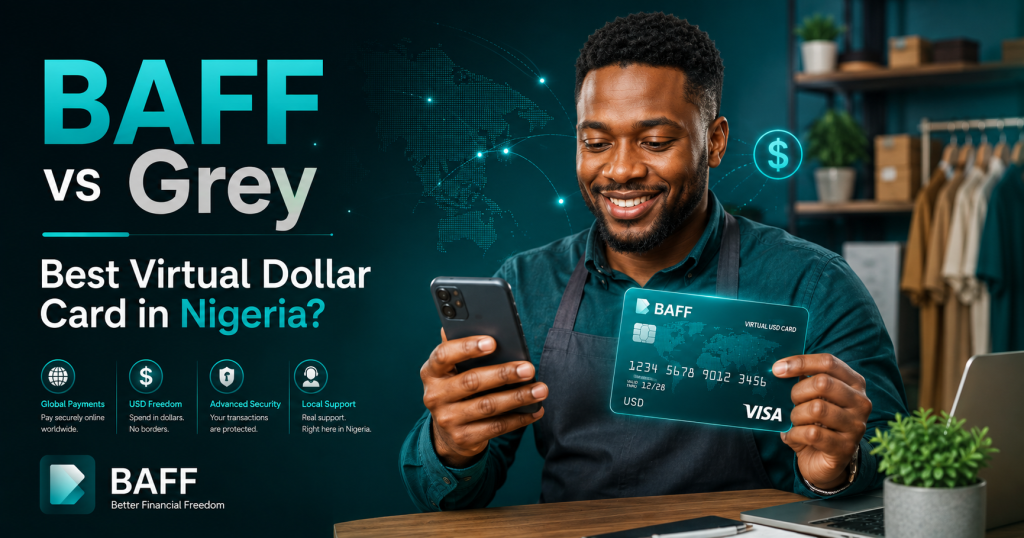
Nigerians who pay for international subscriptions, advertising, software, online courses, travel services, or e-commerce purchases need a dependable USD virtual card. BAFF is built around this everyday Nigerian need, giving users a wallet-based way to access eligible international online payments. Grey is included in this article as a useful comparison point so readers can understand why BAFF may be the better fit for their spending habits.
Both products are designed to help eligible users make international card payments without relying exclusively on a conventional naira debit card. However, they are not identical. Their funding models, published pricing, card controls, wallet structure, limits, and international-payment charges differ.
The short answer is this: BAFF is a strong choice for Nigerians who want a simple local wallet-to-card journey, flexible spending controls, and a currently stated low card-creation offer. Grey may suit users who specifically prefer a documented wallet-linked Visa, Apple Pay or Google Pay support in eligible regions, multiple cards, and clearly published limits. For many Nigerian users paying for subscriptions, ads, software, and online shopping, BAFF offers the more locally aligned starting point.
Important: Fees, limits, card networks, supported countries, and merchant acceptance can change. The comparison below reflects information publicly available on 3 September 2026. Confirm the live terms in each app before creating or funding a card. This is general information, not personal financial advice.
What Is a USD Virtual Card?
A USD virtual card is a digital payment card that exists inside an app or online account rather than as a physical plastic card. It normally has a card number, expiry date, and CVV, and can be used for eligible online transactions wherever the relevant card network and merchant permit it.
For Nigerians, a virtual dollar card can be useful when a merchant does not accept a local naira card, when a payment requires a card issued for international transactions, or when a user wants to keep subscription and advertising expenses separate from a main bank account. However, a virtual card is not a guarantee that every international merchant will approve a payment. The merchant’s country, payment processor, industry code, billing-address checks, recurring-payment rules, and the card issuer’s controls can all affect approval.
A virtual USD card should also not automatically be described as a bank account or credit card. Grey states that it is a financial technology company, not a bank, and that banking services are provided by licensed partners. BAFF likewise presents its product as part of a wider payments and wallet service rather than as a conventional Nigerian bank-issued dollar account.
How BAFF works for Nigerian users
BAFF’s public product page presents a straightforward path: sign up, fund the wallet, and generate a virtual USD card. Create your BAFF account or learn more about the BAFF USD Virtual Card. BAFF says users can fund their wallet by transferring money from an external bank account to a BAFF virtual account after verification, while its page also mentions cash funding through a POS agent.
BAFF’s August 2026 guide adds that users should upgrade to Tier 3, fund the naira wallet, open the USD Virtual Card section, and then create and fund the card. This makes BAFF potentially attractive to users who prefer to start with naira rather than maintain a separate foreign-currency balance before beginning.
BAFF fees and limits
The main BAFF USD-card page advertises transparent pricing but does not show a numerical creation fee or spending limit. A separate BAFF guide dated 24 August 2026 states that the current offer requires $2 to create the card and that the $2 remains available as card balance. Because the information appears in a dated promotional guide rather than a permanent fee table, readers should treat it as a current stated offer, not a guaranteed long-term price.
BAFF advertises customisable spending limits, but the public page does not state a number. This is an important difference from Grey’s published $10,000 daily limit. Before using BAFF for ads, large software bills, or business expenses, check the exact transaction, daily, monthly, and merchant-category limits displayed in your account.
Where BAFF may be useful
BAFF lists international platforms such as Amazon, Netflix, Spotify, Apple, and Google Play as examples of places where the card can be used. Its own guide also discusses use cases such as subscriptions, digital tools, advertising, and international shopping, while warning that acceptance depends on the merchant and payment processor.
That qualification matters. A card can work for one subscription and fail on another because merchants may use different processors, country rules, recurring-payment checks, or identity verification requirements. Users should therefore avoid treating one successful transaction as proof of universal acceptance.
Why Nigerians choose BAFF and what to confirm first
Why BAFF stands out: BAFF offers a Nigerian-focused onboarding flow, wallet funding by bank transfer, a stated low-cost creation offer in its latest guide, customisable spending limits, and quick digital issuance. For Nigerian customers who want to move from a local wallet to eligible international payments without managing a traditional foreign bank account, this is the central BAFF advantage.
Potential drawbacks: BAFF’s public page provides less numerical detail about fees and limits than Grey’s Help Center. The exact exchange rate, transaction charges, refund process, supported card network, and merchant restrictions should be confirmed inside the app or in BAFF’s Terms and Conditions before relying on it for recurring payments.
How Grey works for Nigerian users
Grey’s current card product is a wallet-linked virtual Visa card. After account creation and KYC verification, a user funds a supported wallet and creates the card in the app. Grey says the card can spend directly from USD, EUR, GBP, or other supported balances, meaning there is no separate card top-up step for the Visa product.
This model is convenient for users who want the card balance and wallet balance to remain connected. It also means that a payment can draw from the selected balance, subject to available funds, conversion rules, and the applicable card controls.
Grey fees, limits, and cross-border charges
Grey publishes a $5 one-time Visa-card creation fee and says there are no monthly charges. Grey’s Help Center also says it does not charge card maintenance, transaction, or card-funding fees.
A separate cost can arise when a USD card is used with a non-US merchant or payment processor. Grey explains that a cross-border charge of 2% of the transaction amount plus $0.50 may apply to relevant payments, including cases where the price is displayed in USD but the merchant or processor is outside the United States. This can materially affect small recurring charges, so users should leave a buffer rather than funding an account with exactly the displayed subscription price.
Grey’s Help Center states that users can spend up to $10,000 per day. Its Visa FAQ also says the card cannot be withdrawn from or transferred out of as a card balance; it is intended for card payments. Refunds are settled in USD, and conversion fees are not necessarily refundable.
Grey pros and cons
Potential advantages: Grey provides a detailed public fee and limit schedule, direct wallet-linked spending, 3-D Secure, multiple-card functionality, in-app controls, and Apple Pay or Google Pay support in eligible regions.
Potential drawbacks: The $5 creation fee is higher than BAFF’s currently stated $2 offer. Grey’s cross-border fee can increase the effective cost of non-US payments, and Visa availability or digital-wallet functionality may depend on jurisdiction. Users should also understand that a Grey Visa card cannot be separately topped up or withdrawn from.
BAFF vs Grey: Which Is Cheaper?
On the published creation fees alone, BAFF appears cheaper because BAFF guide states a $2 current offer and the $2 remains as your current balance after card creation, while Grey lists $5 for Visa creation. However, a creation fee is only one part of the total cost.
The more useful question is: What will this card cost for my actual payment pattern? Compare the naira-to-dollar conversion rate, wallet funding charge, card creation fee, cross-border or foreign-exchange charge, declined-transaction charge if any, refund treatment, and any merchant-side fee. A card with a cheaper creation fee may not be cheaper for frequent non-US subscriptions or international advertising if its effective conversion cost is higher.
Why BAFF Works Well for Subscriptions, Ads, and Online Shopping
For subscriptions, Grey’s direct wallet link and 3-D Secure controls may be useful, but users should test a low-cost subscription first and keep enough balance for taxes, temporary authorisations, exchange differences, or cross-border charges. BAFF also lists major subscription platforms, but acceptance remains merchant-dependent. BAFF | USD Virtual Card
For digital advertising, the most important features are not merely the creation fee. Check the daily and monthly spending limits, recurring-payment support, processor location, decline handling, and the ability to freeze or replace the card. Grey publishes a $10,000 daily limit; BAFF advertises adjustable limits but does not publicly state a number on its main card page.
For international shopping, either card may work where the relevant network and merchant accept it. Confirm whether the merchant is US-based, whether billing-address verification is required, and whether the transaction is settled in USD or another currency. Grey’s published cross-border explanation is especially relevant to non-US merchants.
For students, freelancers, and remote workers, a separate virtual card can help organise spending on courses, cloud tools, design software, and productivity platforms. It should still be funded only with money that the user can afford to spend, and its terms should be checked before a recurring payment is authorised.
How to Choose Between BAFF and Grey
Choose BAFF if you want a Nigerian-focused wallet experience, prefer to start from naira, value bank-transfer or POS funding options, want adjustable spending controls, and the live in-app pricing and limits meet your needs. Its stated $2 creation offer is attractive, and the current BAFF guide says the amount remains available as card balance after creation; verify the offer at the point of creation. USD Virtual Card | BAFF
Choose Grey if you prefer a more extensively documented card product with a $5 Visa creation fee, direct wallet-linked spending, a published $10,000 daily limit, 3-D Secure, multiple cards, and Apple Pay or Google Pay support where available. Budget for the possible 2% plus $0.50 cross-border charge on relevant non-US transactions.
If you are undecided, compare both apps using the same test: check KYC requirements, fund a small amount, review the final fee before creating the card, make a low-value payment, and inspect the transaction receipt. Do not begin with a large advertising budget or an important annual subscription.
Frequently Asked Questions Nigerians Ask About USD Virtual Cards
What is the best virtual dollar card in Nigeria?
There is no single best card for every Nigerian user. The right choice depends on fees, funding method, card network, spending limits, merchant acceptance, support, and the type of payment you make. BAFF is the best starting point for readers who want a Nigerian-focused wallet-to-card experience, while Grey is worth comparing as an alternative. Confirm live terms rather than relying on old reviews.
Can I get a USD virtual card in Nigeria without a US bank account?
A US bank account is not automatically required. BAFF says users do not need a US bank account to create its virtual card, . BAFF’s process is based on its own account verification and wallet requirements.
Can I fund a virtual dollar card with naira?
Some products allow users to start with naira and convert or allocate funds through an in-app wallet. BAFF’s guide describes funding a BAFF wallet with naira before creating and funding the USD card. Grey’s exact conversion route depends on the supported wallet and the rate shown in the app. Always review the final amount before confirming.
Can I use BAFF or Grey for Netflix, Spotify, ChatGPT, Canva, or Amazon?
These platforms may accept eligible virtual cards, but no provider can guarantee every merchant, plan, region, or billing flow. BAFF lists Amazon, Netflix, Spotify, Apple, and Google Play. Grey lists Netflix, Spotify, Amazon, Google Ads, Canva, Coursera, Uber, and other examples. A merchant may still decline a card because of country restrictions, recurring-payment rules, processor controls, or insufficient balance.
Can I use a virtual dollar card for Facebook, Meta, TikTok, or X ads?
Yes, with BAFF USD Virtual Card, you can pay for any eligible international transactions or subscriptions.
Why is my virtual dollar card being declined?
Common reasons include insufficient balance, an incorrect card detail, an expired card, a merchant or processor restriction, a billing-address mismatch, a card limit, a blocked merchant category, or a country limitation. Grey specifically advises checking the balance and spend limit and notes that processor restrictions can affect certain services. BAFF likewise advises checking card details, balance, and merchant acceptance.
Are virtual dollar cards safe to use?
They can reduce the need to expose a primary bank-card number, but they are not risk-free. Use strong account security, enable biometric or two-factor protection where available, avoid sharing the CVV, freeze the card when not needed, and monitor every transaction. BAFF describes PIN, biometric authentication, and encryption, while Grey highlights 3-D Secure and in-app controls.
Can I withdraw money from my Grey Visa virtual card?
Grey’s Visa FAQ says withdrawals and transfers are not supported on the Visa card; it is intended for card payments. Do not confuse Grey’s Visa rules with older or region-specific Mastercard documentation, because card type and availability can differ by jurisdiction.
Does Grey charge a monthly fee?
Grey says there is no monthly maintenance fee. Its current Help Center also says there are no card transaction or card-funding fees, but a relevant non-US transaction may still attract the cross-border charge described by Grey.
Does BAFF charge a fee to create a USD virtual card?
BAFF’s latest dated guide states a $2 current offer and says the amount remains available as card balance after creation. The main BAFF product page does not show a numerical fee, so confirm the final price in the app before creating the card.
Can I use a virtual dollar card to receive money?
A virtual card is generally designed for card payments, not for receiving salary, freelance income, or bank transfers. Use the provider’s supported wallet or foreign-currency account features for receiving money, and check the terms before sending funds to a card number.
Are virtual dollar cards regulated in Nigeria?
The regulatory status depends on the provider, issuer, banking partner, payment service, and transaction type. Users should read the provider’s legal disclosures, privacy policy, terms, supported-country list, and complaints process. Nigeria’s central bank publishes regulatory information and payment-system updates through its official website. Do not assume that a fintech app has the same protections, dispute process, or deposit insurance as a Nigerian commercial bank.
Final Verdict: Why BAFF Deserves First Consideration
BAFF is the stronger starting point for Nigerian users who prioritise a local wallet journey, naira funding options, adjustable spending controls, quick issuance, and a lower currently stated creation offer. Grey is worth considering for users who prioritise detailed published card rules, direct wallet-linked spending, digital-wallet support in eligible regions, and a clearly disclosed daily limit.
Neither card is universally better. If you primarily want a Nigerian-facing wallet-to-USD-card workflow, local funding convenience, and a low-cost way to begin, BAFF may be the more suitable option. If you specifically need Grey’s wallet-linked Visa model or digital-wallet features where available, Grey may be worth testing as an alternative.
If you choose BAFF, start by completing the required verification, fund your wallet with a small amount, review the final fee and card terms shown in the app, and test the card on a low-value eligible payment. Keep a backup payment method for important subscriptions or campaigns. Product pages and app terms are the final authority because virtual-card pricing, limits, supported merchants, and card availability can change.