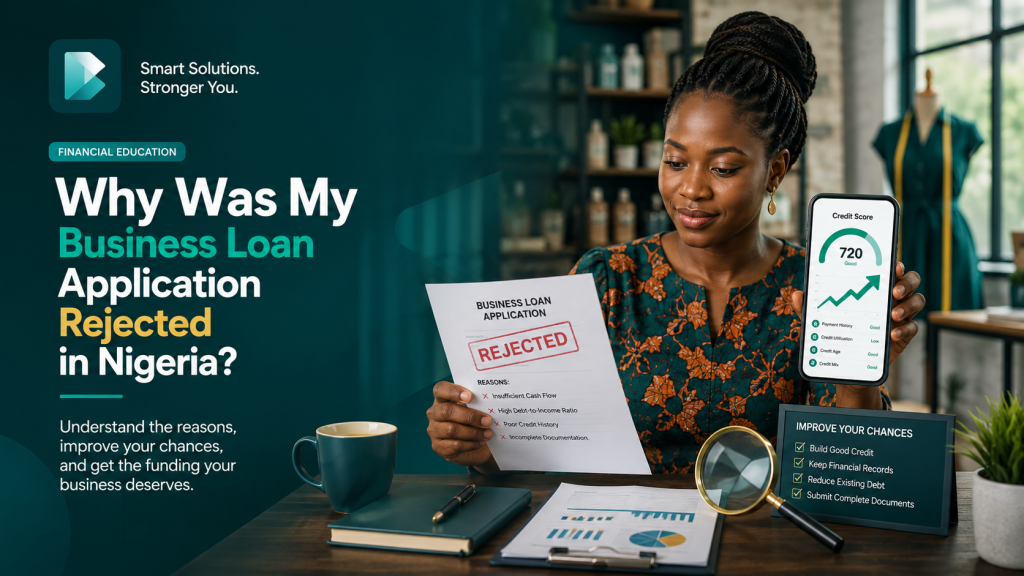
Applying for a business loan can be stressful, especially when you need money for stock, equipment, payroll, rent, or an urgent supplier payment. A rejection can feel personal, but lenders usually make decisions by assessing risk: your repayment history, current obligations, business cash flow, documentation, and the amount you requested.
If your business loan was rejected in Nigeria, the next step is not always to submit another application immediately. First, find out what may have weakened your application. Checking your credit information, reviewing your loan history, and comparing the requested amount with your business’s repayment capacity can help you make a stronger application next time.
Before you reapply: Check your credit score and loan history in the BAFF app, then review your business finances and documents carefully. A stronger application begins with a clearer picture of your financial position.
8 common reasons business loan applications are rejected in Nigeria
There is no single rejection rule that applies to every lender. Banks, fintech lenders, and other financial institutions may use different eligibility criteria, scoring models, documentation requirements, and affordability tests. However, the following issues commonly make an application appear riskier.
| Possible reason | What the lender may be assessing | What you can do before reapplying |
| Poor or damaged credit history | Whether previous credit was repaid as agreed | Check your credit information and resolve overdue accounts or reporting errors |
| Existing unpaid loans | Whether you already have obligations that reduce repayment capacity | List all debts, bring overdue accounts up to date where possible, and avoid taking on unaffordable new credit |
| Unstable business cash flow | Whether the business can meet repayments during good and slow months | Prepare cash-flow records and request an amount aligned with realistic free cash flow |
| High requested amount | Whether the facility is too large for the business’s income and history | Start with a responsible amount and show how the funds will be used |
| Incomplete or inconsistent information | Whether the application can be verified | Use accurate details and make sure your identity, business, bank, and application information agree |
| Short business history | Whether the lender has enough evidence of trading performance | Keep clear records and build a consistent transaction and repayment history |
| Weak business records | Whether revenue, expenses, and purpose of borrowing can be understood | Organise statements, invoices, receipts, registration documents, and supplier information |
| Too many recent applications | Whether several new credit enquiries suggest financial pressure | Pause, identify the original issue, and improve the application before applying again |
1. Your credit history shows late or missed repayments
Payment history is one of the first areas lenders may consider. Late payments, unpaid balances, defaults, or accounts reported as delinquent can make a lender question whether a new facility will be repaid on time. This can affect you even when the new loan is for a profitable business purpose. Business Loan | BAFF
The Central Bank of Nigeria explains that consolidated credit information helps banks assess a borrower’s repayment capability and identify borrowers with non-performing or unserviced debts elsewhere. That is why an applicant should review their credit position before submitting a new application rather than assuming that a lender will only look at the business’s current request.
You can start by checking your credit score and available credit metrics on BAFF. BAFF describes its credit-score feature as a way to track credit over time, review loan history, and understand factors such as payment history, credit utilisation, credit history length, and new credit.
2. You have unpaid or excessive existing obligations
A business may be generating revenue and still be unable to support another repayment. Lenders may consider existing loans, overdrafts, credit lines, supplier obligations, personal debt linked to the business owner, and other recurring commitments.
The key question is not only, “How much money enters the business?” It is also, “How much remains after operating costs and existing repayments?” If most of your monthly inflow is already committed, a lender may reject the application or offer a smaller amount.
Before reapplying, create a simple debt and cash-flow summary. Record each outstanding balance, monthly repayment, due date, and interest cost. Then compare the total with the amount your business can realistically spare after essential expenses.
3. Your business cash flow is too irregular
Many Nigerian businesses have seasonal or uneven income. A business may record strong sales during festive periods or market cycles and much lower inflows in other months. If the application does not show how repayments will be managed during slower periods, the lender may view the income as insufficiently predictable.
This does not necessarily mean the business is unprofitable. It may mean the application did not demonstrate repayment capacity clearly enough. Bank statements, transaction records, invoices, receipts, inventory evidence, and a short explanation of seasonality can help a lender understand the business beyond a single month’s balance.
BAFF describes its business loan as revolving credit that can be used and repaid within a credit limit. Its product page says the facility may help businesses manage cash flow, operational costs, seasonal expenses, inventory, and short-term opportunities. Even with a flexible facility, the amount requested should still match the business’s likely repayment capacity.
4. You requested more than your business can comfortably repay
A larger loan is not automatically a better loan. Requesting an amount that is high compared with your revenue, business history, existing obligations, or available security can increase the perceived risk of the application.
A practical approach is to calculate the exact funding gap. Explain what the money will pay for, how that spending is expected to support revenue or operations, and how the repayment will fit into the business’s cash flow. A focused request is often easier to assess than a broad request for “business expansion.”
If a lender declines a large request, do not assume that every future application will fail. First, reduce the amount only if the smaller facility remains affordable and useful, and only after checking the lender’s terms, total cost, and repayment schedule.
5. The information in your application is incomplete or inconsistent
A lender may pause or reject an application when key details cannot be verified. Common examples include a mismatch between the applicant’s name and bank-account details, inconsistent business addresses, incorrect phone numbers, unclear ownership information, missing documents, or unexplained differences between stated revenue and account activity.
Accuracy matters more than presenting an impressive story. Review every field before submitting an application. Use current contact details, provide genuine business information, and ensure that uploaded documents are readable and valid. Never inflate revenue or hide an existing obligation; inaccurate information can create a more serious problem than a straightforward rejection.
6. Your business has too little operating history
A new business may have a strong idea but limited evidence of consistent sales, expenses, and repayment behaviour. Without enough operating history, a lender may have difficulty estimating future cash flow and the probability of repayment.
You can improve your position by separating business and personal transactions where possible, keeping regular financial records, saving invoices and receipts, and building a consistent record of responsible credit use. The goal is to make the business easier to understand and verify over time.
7. Your business records do not support the application
A loan application is stronger when the business can show where money comes from, where it goes, and why the requested facility is needed. Weak or incomplete records can make a genuine business look riskier than it is.
Prepare a basic document folder containing recent bank statements, sales records, expense records, invoices, supplier details, registration information where applicable, and a short use-of-funds explanation. The exact requirements vary by lender, so always check the lender’s current terms before submitting documents.
8. You applied for several loans in a short period
Repeated applications can be a sign that a borrower is under financial pressure, particularly when they follow one another without addressing the original reason for rejection. BAFF identifies “new credit” as one of the factors users can monitor in its credit-score feature.
If an application is declined, take time to review your credit information, affordability, documentation, and requested amount. Applying everywhere at once may make it harder to understand what went wrong and can create additional financial pressure.
How to check your credit report and score before reapplying
A credit check should be part of your preparation, not something you do only after a lender says no. BAFF’s official guidance says users can download the app, sign in or sign up, open the credit-score section, and view their metrics and loan history in one place.
Follow these steps in the BAFF app
1.Download BAFF: Get the app from the Apple App Store or Google Play.
2.Sign in or create an account: Use your correct personal information so your credit information can be matched accurately.
3.Open the credit-score section: Review the score, available metrics, and loan history shown in the app.
4.Look for warning signs: Pay particular attention to missed repayments, outstanding balances, high utilisation, or recent credit activity.
5.Create a correction plan: If you find an overdue account, contact the relevant lender. If information appears incorrect, ask the reporting institution or appropriate credit bureau how to dispute it.
6.Recheck before applying: Once you have addressed the issue and your finances are ready, reassess the amount and purpose of the new facility.
BAFF’s credit-score page is designed to help users understand their credit position, but no app can guarantee that a lender will approve an application. Each lender makes its own decision based on its policies, product terms, verification process, and assessment of affordability.
What to do if you believe your credit report is wrong
Do not ignore an error. Check the account name, outstanding balance, repayment status, dates, and personal details shown in your credit information. Keep copies of supporting evidence, such as receipts, settlement letters, bank statements, and correspondence with the lender.
CreditRegistry Nigeria’s FAQ covers access to credit information and correcting discrepancies in credit reports. You can also consult the relevant lender or credit bureau directly for the formal correction process. Resolve genuine debts through the lender, and dispute only information you believe is inaccurate or incomplete.
How to improve your chances of approval next time
Start with visibility. Review your BAFF credit score and loan history before you apply, because you cannot prepare for a problem you have not identified. Next, bring overdue obligations under control where possible and avoid borrowing an amount that would leave the business unable to pay staff, suppliers, rent, taxes, or other essential costs.
Then improve the quality of your application. Keep business records current, provide consistent information, explain the purpose of the loan, and show how expected cash flow will support repayment. If the business has seasonal income, present the pattern clearly rather than relying on one unusually strong month.
Finally, read the lender’s terms carefully. Check the interest rate, fees, repayment frequency, late-payment consequences, collateral or guarantees, and total amount repayable. A loan is useful only when the business can afford the full repayment obligation.
Ready to check your credit position?
Do not wait for another rejection to find out what a lender may see. Download the BAFF app and review your credit score, credit metrics, and loan history before you apply for business credit.
Check your credit score on BAFF
Download BAFF on the Apple App Store
If you are looking for flexible business credit for vendors, suppliers, cash-flow gaps, inventory, or operating expenses, learn more about BAFF Business Loans. BAFF says its business-loan application can receive a credit decision in as little as three minutes and that funds may be available the same day if approved; timing and approval remain subject to BAFF’s applicable assessment and terms.
Important: Checking your credit information can help you prepare, but it does not guarantee loan approval. Borrow only what your business can afford to repay and review all applicable lender terms before accepting credit.
Frequently asked questions
Why was my business loan rejected in Nigeria?
Common reasons include late or missed repayments, existing unpaid loans, unstable cash flow, a high requested amount, incomplete information, limited business history, weak financial records, or several recent applications. The exact reason depends on the lender and product.
Does a low credit score automatically mean I cannot get a business loan?
Not necessarily. Lenders may consider credit information alongside cash flow, affordability, business history, documentation, and the purpose of borrowing. However, a weak credit profile can reduce your chances or affect the amount and terms offered.
How can I check my credit score before applying for a loan?
Download the BAFF app, sign in or sign up, and open the credit-score section. BAFF says users can view credit metrics and loan history there.
Can I apply again after a loan rejection?
You can, but it is usually sensible to first identify and address the likely issue. Review your credit information, outstanding obligations, cash flow, documents, and requested amount. Reapply only when the application is accurate and the repayment is affordable.
Does BAFF guarantee business-loan approval?
No. BAFF provides access to credit metrics and offers business-credit products, but approval depends on the applicable assessment, eligibility criteria, verification, and product terms.