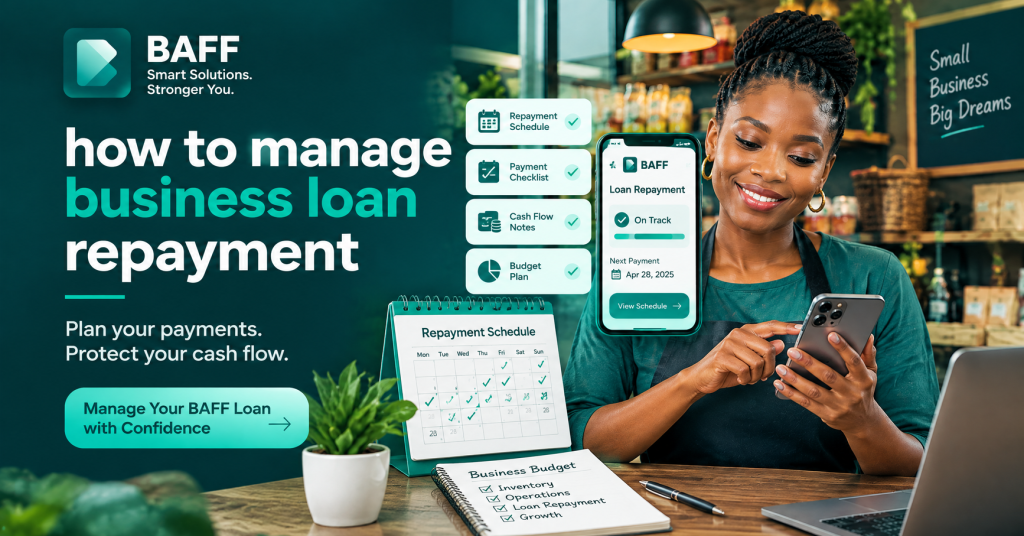
Start with the repayment number, not the loan amount
Before spending borrowed money, write down the repayment amount, due date, repayment frequency, total cost, and any applicable fees shown in your offer. Do not rely on memory or on the amount that entered your account. The amount you must repay is the figure that belongs in your business plan.
Create a one-page repayment summary showing the amount received, purpose, total amount due, each due date, the income source for repayment, and a backup action if that income arrives late.
If you have a BAFF offer, review the final amount, rate, fees, term, and repayment details before accepting. BAFF advertises business loans up to ₦10,000,000, with affordable rates, flexible repayment plans, and fast approval subject to eligibility. Your profile and current terms determine the actual offer.
Build a repayment plan around real cash flow
A repayment plan should follow the timing of money in and money out. Profit on paper does not always mean cash is available on the due date: a freelancer may be awaiting a client payment, a trader may need sales cash to restock, and an online seller may have money tied up in delivery or returns.
Make a simple weekly cash-flow forecast
For the next eight to twelve weeks, list expected cash received and paid each week. Include sales, invoices, key operating costs, and the repayment. Use conservative sales estimates.
Mark repayment weeks. If a due date falls before customers usually pay, move money into a separate repayment wallet as sales come in rather than waiting for the full amount.
Separate business money from personal money
Use a dedicated business wallet or account for sales and operating costs where possible. Pay yourself a planned amount instead of taking random withdrawals from the repayment pool. A provisions-shop owner who sells ₦80,000 in a week, for example, must first account for restocking, transport, staff support, and the upcoming repayment before treating anything as available income.
Match the repayment to the use of the loan
The safest repayment source is usually connected to the reason you borrowed. Track stock sales, orders completed with new equipment, or customer payments for an online order, and reserve repayment after related costs.
If stock is not moving, investigate pricing, product selection, promotion, and inventory before using another loan. New debt should not hide an unsolved cash-flow problem.
Use a repayment routine that takes less than 15 minutes
A consistent routine is more effective than a spreadsheet you stop updating. Choose one day each week to:
1.Check the next repayment date and amount.
2.Compare reserved money with the amount still needed.
3.Review sales, unpaid invoices, and essential expenses.
4.Move what you can safely reserve into the repayment pot.
5.Act on any shortfall by collecting an overdue invoice, reducing a non-essential purchase, or contacting the relevant provider early.
Keep confirmation messages, receipts, and your own payment record. If you manage BAFF services in the app, review the applicable information, terms, and privacy policy.
What to do when sales drop or payment is late
A difficult month is a reason to act early. Calculate the gap, then protect income-generating stock, agreed wages, necessary utilities, and customer commitments.
Contact the relevant provider through its official channel and ask what is available under your agreement. Do not assume a new loan, rollover, or missed payment is harmless; review any revised cost or term in writing.
If you have a complaint about a regulated financial institution, the Central Bank of Nigeria advises contacting the institution first. Unresolved complaints may be escalated to the CBN Consumer Protection Department after the institution’s process and timeline. Keep transaction records, but never share your PIN or password.
A realistic affordability check before borrowing
Before applying, ask yourself:
Can my normal business cash flow cover this repayment?
Use an ordinary month, not a record month. If repayment only works when every customer pays on time, consider a smaller amount, different timing, or postponing the borrowing.
What happens if sales fall for two weeks?
List expenses you could pause and income you could collect sooner. Do not empty money needed for food, rent, healthcare, wages, or core operations to borrow more than you can manage.
Is the borrowing solving a clear business need?
Borrowing for identifiable stock, equipment, or a confirmed order is easier to monitor than borrowing because the business “feels short.” If the issue is low margins, weak records, slow stock, or unpaid invoices, address it first. A loan cannot automatically repair a business model.
BAFF loans are not suitable for everyone. Eligibility, amount, pricing, fees, term, and approval depend on your profile and current terms. Read the offer carefully and borrow only what you can repay.
Practical examples for Nigerian small businesses
A market trader: Reserve a portion of daily sales before buying new stock, and watch slow-moving items so capital is not trapped.
A freelancer: Invoice promptly, use deposits where normal practice allows, and do not count an unpaid invoice as cash.
An online seller: Separate customer order money from profit and account for delivery, returns, packaging, and payment charges.
A salon or repair business: Record each job’s materials cost and reserve repayment from what remains, not from gross takings.
For stronger records, explore BAFF Books and BAFF’s online-selling and business tools. Check your agreement and cash flow separately.
How BAFF can fit into your plan
If you are considering BAFF, start with the business loan page. Complete applicable identity and account verification, then review your offer. Do not treat an advertised maximum as an amount you should expect to receive.
You can download the BAFF app, or find it on the Apple App Store and Google Play. Our business-loan guide can help you prepare, but does not replace your offer.
Ready to check your options? Visit BAFF, review current information, and use the checklist before deciding. Leave room for the business to operate.
Frequently asked questions
What is the best way to manage business loan repayment?
Start with due dates and total cost, then reserve money from real business cash flow before it is spent. Forecast weekly and respond early to shortfalls.
Should I use all my sales to repay a business loan faster?
Not automatically. Fund essential operating costs and personal necessities first, and check your agreement before making extra payments.
What if my customer has not paid before my due date?
Calculate the shortfall early, follow up, reduce non-essential spending, and contact the provider. Another loan may not be the right solution.
Can I use a new loan to repay an old business loan?
It can create a debt cycle if the cash-flow problem remains. Compare the complete cost and risk, and proceed only if normal cash flow can support it.
Does BAFF guarantee business-loan approval or a particular rate?
No. BAFF’s business-loan amount, interest, fees, term, approval, and availability depend on eligibility, your profile, and current terms. Review your own offer rather than relying on a general advertisement.
Where can I learn more about Nigerian small-business support?
SMEDAN provides knowledge, funding, tools, and market-support information for MSMEs. Its official About Us page is a useful starting point.